Special Issue on the 20th Anniversary of ACM International Conference on Multimedia
|
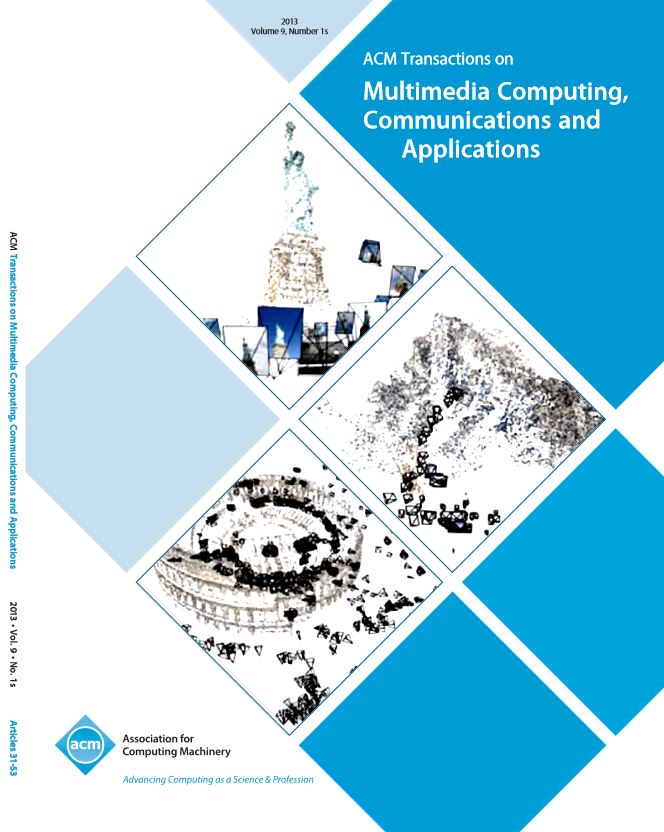 We are proud to present this collection of articles to honor the 20th anniversary of the establishment of the premier conference of the ACM Special Interest Group on Multimedia (SIGMM). The ACM International Conference on Multimedia (ACM Multimedia) was first held in 1993. It has been a wonderful 20 years, with interesting data, problems and solutions. We hope you share our enthusiasm for where the field has come from, and the potential that awaits us.
Multimedia is ubiquitous in our daily lives. We speak to our phones and computers, cameras are everywhere, and the average consumer watches hours of multimedia content each week. None of this would be possible without the work done by this community. We compress the content, analyze it, stream it, index it, and allow users to find the media that they want. Right now!
This special issue combines longer review articles, summarizing where the field has come from, with shorter personal notes explaining how we got to where we are and where we might go next. We cannot possibly summarize all the multimedia work that has been done and remains to be done. The articles in this issue are an attempt to summarize a large field and its successes. We will let the authors speak for themselves.
Long Review Articles: In the space of longer review articles, authors survey areas ranging from video transport and multimedia synchronization, topics that were researched and published in the very first ACM Multimedia conferences, to multimedia authoring and image search topics.
In the paper Two Decades of Internet Video Streaming: A Retrospective View, authors Baochun Li, Zhi Wang, Jiangchuan Liu and Wenwu Zhu present a retrospective view of the research problems (and solutions) to which the academic and industry communities directed substantial amounts of attention. These range from streaming-video transport protocols, peer-to-peer streaming protocols to Dynamic Adaptive Streaming over HTTP and the effects of cloud computing and social media on video streaming.
The authors Zixia Huang, Klara Nahrstedt and Ralf Steinmetz, take a historical viewpoint on temporal multimedia synchronization in the paper Evolution of Temporal Multimedia Synchronization Principles: A Historical Viewpoint. From the very first synchronization models and seminal synchronization skew measurements, to the synchronization demands that new multi-modal 3D systems require, the authors discuss the lessons learned from past and present approaches. They lay out the needs for future synchronization frameworks.
Multimedia authoring has been researched and published in ACM Multimedia conferences from the beginning, as authors Dick Bulterman, Pablo Caesar and Rodrigo Laiola Guimaraes discuss in the paper Socially-aware Multimedia Authoring: Past, Present and Future. However, it has been a very challenging topic, especially supporting new socially-aware multimedia authoring needs. They argue that providing support for socially-aware multimedia authoring is of great importance, and it will create highly personal media experience, as well as have profound impact on the nature of the entire multimedia information processing pipeline.
Comprehensive review and analysis of image search over the past 20 years is presented in the paper Image Search - From Thousand to Billions in 20 Years, co-authored by Lei Zhang and Yong Rui. The authors outline the research progress that the community has achieved starting from searching over few hundred images, major breakthroughs around the year 2000 in image search features, indexing methods and commercial systems, to searching over billions of images, big data potential and future research directions in effective visual representation, crowdsourcing and creative multimedia interfaces.
Short Articles: In addition to long survey papers, we have invited leaders in the community to provide short essays including their more personal view on particular multimedia topics. Authors' contributions range from very personal views on their own research to general assessments about where we are as a community. Here we briefly survey the various opinions that readers can find under the short paper contributions. We will discuss the short contributions according to the “multimedia protocol stack� in a bottom up approach, starting from multimedia systems to human-computer interfaces.
Contributions in Multimedia Systems and Communication: In Looking Forward 10 Years to Multimedia Success, Lawrence A. Rowe takes us back to the retreat at ACM Multimedia 2003 in Berkeley, California, and evaluates from his perspective the kinds of progress the multimedia community made regarding the challenges outlined ten years ago, including multimedia authoring, distributed collaboration and ubiquitous capturing and using digital media.
Prashant Shenoy examines in his paper Multimedia Systems Research: The first Twenty Years and Lesson for the Next Twenty three multimedia research problems that have been hot topics in the past 20 years: making video on demand a success, UDP-based streaming and Quality of Service in operating systems. He presents the evolution of these topics and his view of impact and lessons learned for future research in the field.
Video streaming is the core technology of multimedia delivery systems and Kien A. Hua discusses in Online Video Delivery: Past, Present and Future the challenges and lessons learned to realize efficient distribution of video over wired and wireless Internet. He argues that Video-on-Demand (VOD) systems went through broadcasting, patching, chaining and other techniques to finally enable video delivery anywhere and anytime as we are used to now.
Viswanathan Swaminathan makes a very different point than Kien A. Hua, more from an industrial point of view, about video streaming in his contribution Are We in the Middle of a Video Streaming Revolution?. He argues that until very recently, video streaming experiences left much to be desired and only over the last few years this has significantly improved, delivering real value to users and making it possible to monetize streaming.
In the short note Advances in Immersive Communication: 1) Telephone, 2) television, 3) Teleportation, Philip A. Chou makes an argument for a major multimedia impact in future fully immersive communication. He stresses that due to convergence of massive amounts of computation, bandwidth and resolution, new sensors and new displays, multimedia community may advance the field towards teleportation.
Contributions in Multimedia Information Retrieval: The short contribution How Far We've Come: Impact of 20 Years of Multimedia Information Retrieval by Shi-Fu Chang provides an extensive review of major research trends in the last two decades in multimedia information retrieval. Shi-Fu furthermore assesses impacts of these trends on real-world applications.
Wolfgang Effelsberg has worked on multimedia content analysis from the beginning of the ACM Multimedia Conference. He takes a personal look at audio and video content analysis research in the short note A Personal Look Back at Twenty Years of Research in Multimedia Content Analysis. He argues that the various advances in analysis, indexing and retrieval helped us significantly in recognition of specific objects and events and are now part of many real-world applications.
In Multimedia Retrieval that Matters, Alan Hanjalic emphasizes that multimedia information retrieval (MIR) research should refocus on bridging the utility gap, the gap between the expected and de-facto usefulness of MIR solutions. He argues we should revisit the foundations of MIR solutions and consider a utility-by-design approach rather than incremental steps.
The first ACM Multimedia conference coincided with a surge of innovative solutions in the space of computer vision, especially for face-recognition problems. The Eigenfaces approach for solving the face recognition problems captured much initial attention and has been used as a benchmark over twenty years later. Matthew Turk, being at the center of early face recognition efforts, takes a brief personal view of the genesis of Eigenfaces for face recognition in the contribution Over 20 Years of Eigenfaces.
Brian Whitman, the co-founder of The Echo Nest Corporation, discusses the notion of 'care & scale', cultural analysis of music and overall history of music retrieval in the brief contribution Care & scale: fifteen years of music retrieval. He argues that special care is needed when addressing multimedia problems because the signals have real meanings to real users.
Contributions in Human-Computer Interfaces: The last decade has seen an explosion of multimedia content. One way to manage the wealth of data in image databases is to create 3D scene models to help find and navigate the most interesting photographs in an interactive, immersive 3D setting. In Navigating the Worldwide Community of Photos, authors Richard Szeliski, Noah Snavely and Steven Seitz discuss challenges when exploring this space and point out how finding new relationships among photographs opens up exciting new possibilities for multimedia authoring, visualization and editing.
Elisabeth Andre discusses challenges that arise when exploiting unconscious human signals for empathic stimulation in multi-modal human-computer interaction. In her contribution Exploiting Unconscious User Signals in Multimodal Human-Computer Interaction, she argues for the real-time analysis of psychological user states and smooth adaptation of the human-machine interface based on this analysis.
Multi-sensory experiences and experiential media systems are the core of the discussion in the short paper Experiential Media Systems by Hari Sundaram. On two different research initiatives he poses the questions of multi-sensory integration and super-additivity, the need for identification of "first class"� multimedia problems and for expanding the scope of multimedia research.
In summary, recent years have seen an explosion of research and technologies in multimedia beyond individual algorithms, protocols and small-scale systems. The scale of multimedia innovations and deployment exploded with unimaginable speed. Hence, as the multimedia area is growing fast and penetrating every facet of our society, this special issue in TOMCCAP fills an important need to look back at the multimedia research achievements over the past 20 years and celebrate the exciting potential. We hope you enjoy our "Back To The Future"� journey.
Klara Nahrstedt, Rainer Lienhart, and Malcolm Slaney
Guest Editors
|
|
|
|